Chemistry Unit 4 Review Mathematical Modeling of Gases
A mathematical model is a description of a system using mathematical concepts and language. The process of developing a mathematical model is termed mathematical modeling. Mathematical models are used in the natural sciences (such equally physics, biology, earth scientific discipline, chemical science) and engineering disciplines (such equally information science, electrical engineering), likewise as in non-concrete systems such every bit the social sciences (such every bit economics, psychology, sociology, political scientific discipline). The utilise of mathematical models to solve problems in business or military operations is a large function of the field of operations inquiry. Mathematical models are also used in music,[1] linguistics,[2] and philosophy (for example, intensively in analytic philosophy).
A model may assistance to explain a system and to study the effects of different components, and to make predictions most beliefs.
Elements of a mathematical model [edit]
Mathematical models can take many forms, including dynamical systems, statistical models, differential equations, or game theoretic models. These and other types of models can overlap, with a given model involving a diverseness of abstruse structures. In general, mathematical models may include logical models. In many cases, the quality of a scientific field depends on how well the mathematical models developed on the theoretical side agree with results of repeatable experiments. Lack of agreement between theoretical mathematical models and experimental measurements oftentimes leads to important advances as ameliorate theories are developed.
In the physical sciences, a traditional mathematical model contains most of the following elements:
- Governing equations
- Supplementary sub-models
- Defining equations
- Constitutive equations
- Assumptions and constraints
- Initial and boundary conditions
- Classical constraints and kinematic equations
Classifications [edit]
Mathematical models are usually composed of relationships and variables. Relationships tin be described by operators, such as algebraic operators, functions, differential operators, etc. Variables are abstractions of organisation parameters of involvement, that tin be quantified. Several classification criteria can be used for mathematical models according to their structure:
- Linear vs. nonlinear: If all the operators in a mathematical model exhibit linearity, the resulting mathematical model is defined equally linear. A model is considered to be nonlinear otherwise. The definition of linearity and nonlinearity is dependent on context, and linear models may accept nonlinear expressions in them. For example, in a statistical linear model, it is causeless that a relationship is linear in the parameters, only information technology may exist nonlinear in the predictor variables. Similarly, a differential equation is said to be linear if it can be written with linear differential operators, but information technology tin still have nonlinear expressions in it. In a mathematical programming model, if the objective functions and constraints are represented entirely by linear equations, so the model is regarded as a linear model. If one or more than of the objective functions or constraints are represented with a nonlinear equation, and so the model is known as a nonlinear model.
Linear structure implies that a problem can be decomposed into simpler parts that can be treated independently and/or analyzed at a different scale and the results obtained volition remain valid for the initial problem when recomposed and rescaled.
Nonlinearity, even in adequately uncomplicated systems, is often associated with phenomena such every bit chaos and irreversibility. Although there are exceptions, nonlinear systems and models tend to exist more than difficult to study than linear ones. A common approach to nonlinear problems is linearization, but this can exist problematic if i is trying to study aspects such as irreversibility, which are strongly tied to nonlinearity. - Static vs. dynamic: A dynamic model accounts for time-dependent changes in the country of the system, while a static (or steady-country) model calculates the organisation in equilibrium, and thus is time-invariant. Dynamic models typically are represented past differential equations or difference equations.
- Explicit vs. implicit: If all of the input parameters of the overall model are known, and the output parameters tin can be calculated by a finite series of computations, the model is said to be explicit. But sometimes it is the output parameters which are known, and the corresponding inputs must exist solved for past an iterative procedure, such as Newton'due south method or Broyden'south method. In such a case the model is said to be implicit. For instance, a jet engine's concrete properties such as turbine and nozzle pharynx areas can be explicitly calculated given a blueprint thermodynamic bike (air and fuel menses rates, pressures, and temperatures) at a specific flying status and ability setting, just the engine'due south operating cycles at other flight conditions and power settings cannot exist explicitly calculated from the abiding physical properties.
- Discrete vs. continuous: A discrete model treats objects as discrete, such as the particles in a molecular model or the states in a statistical model; while a continuous model represents the objects in a continuous fashion, such every bit the velocity field of fluid in pipe flows, temperatures and stresses in a solid, and electrical field that applies continuously over the entire model due to a point charge.
- Deterministic vs. probabilistic (stochastic): A deterministic model is i in which every prepare of variable states is uniquely adamant by parameters in the model and by sets of previous states of these variables; therefore, a deterministic model ever performs the same style for a given set up of initial conditions. Conversely, in a stochastic model—ordinarily called a "statistical model"—randomness is present, and variable states are not described past unique values, merely rather past probability distributions.
- Deductive, anterior, or floating: A deductive model is a logical structure based on a theory. An inductive model arises from empirical findings and generalization from them. The floating model rests on neither theory nor ascertainment, just is but the invocation of expected structure. Application of mathematics in social sciences outside of economic science has been criticized for unfounded models.[three] Awarding of ending theory in science has been characterized as a floating model.[4]
- Strategic vs non-strategic Models used in game theory are different in a sense that they model agents with incompatible incentives, such as competing species or bidders in an sale. Strategic models presume that players are autonomous decision makers who rationally choose actions that maximize their objective function. A key claiming of using strategic models is defining and computing solution concepts such every bit Nash equilibrium. An interesting property of strategic models is that they separate reasoning almost rules of the game from reasoning about beliefs of the players.[five]
Construction [edit]
In business and engineering, mathematical models may be used to maximize a certain output. The system nether consideration will require certain inputs. The organization relating inputs to outputs depends on other variables also: conclusion variables, state variables, exogenous variables, and random variables.
Determination variables are sometimes known as independent variables. Exogenous variables are sometimes known as parameters or constants. The variables are not contained of each other every bit the state variables are dependent on the decision, input, random, and exogenous variables. Furthermore, the output variables are dependent on the state of the system (represented by the land variables).
Objectives and constraints of the system and its users can be represented as functions of the output variables or state variables. The objective functions volition depend on the perspective of the model's user. Depending on the context, an objective office is likewise known as an index of performance, as information technology is some measure of interest to the user. Although there is no limit to the number of objective functions and constraints a model tin take, using or optimizing the model becomes more involved (computationally) as the number increases.
For example, economists often utilise linear algebra when using input-output models. Complicated mathematical models that have many variables may be consolidated by use of vectors where one symbol represents several variables.
A priori information [edit]

To analyse something with a typical "black box approach", only the behavior of the stimulus/response will exist deemed for, to infer the (unknown) box. The usual representation of this blackness box system is a information flow diagram centered in the box.
Mathematical modeling bug are often classified into black box or white box models, according to how much a priori information on the system is available. A black-box model is a system of which there is no a priori data bachelor. A white-box model (likewise called glass box or articulate box) is a organisation where all necessary information is available. Practically all systems are somewhere between the black-box and white-box models, so this concept is useful only as an intuitive guide for deciding which approach to take.
Usually it is preferable to use as much a priori information every bit possible to make the model more accurate. Therefore, the white-box models are usually considered easier, because if you lot have used the information correctly, then the model volition behave correctly. Often the a priori information comes in forms of knowing the type of functions relating different variables. For example, if we make a model of how a medicine works in a human being system, we know that usually the corporeality of medicine in the blood is an exponentially decaying function. But we are however left with several unknown parameters; how chop-chop does the medicine amount disuse, and what is the initial amount of medicine in blood? This case is therefore not a completely white-box model. These parameters take to be estimated through some means before 1 can utilise the model.
In black-box models i tries to estimate both the functional class of relations between variables and the numerical parameters in those functions. Using a priori information we could end up, for example, with a set of functions that probably could describe the organisation fairly. If at that place is no a priori information nosotros would attempt to apply functions equally general as possible to comprehend all dissimilar models. An oft used approach for black-box models are neural networks which unremarkably do not make assumptions near incoming data. Alternatively the NARMAX (Nonlinear AutoRegressive Moving Average model with eXogenous inputs) algorithms which were developed as part of nonlinear system identification[6] can exist used to select the model terms, determine the model structure, and approximate the unknown parameters in the presence of correlated and nonlinear noise. The advantage of NARMAX models compared to neural networks is that NARMAX produces models that can exist written down and related to the underlying procedure, whereas neural networks produce an approximation that is opaque.
Subjective information [edit]
Sometimes it is useful to comprise subjective information into a mathematical model. This can be done based on intuition, experience, or expert opinion, or based on convenience of mathematical course. Bayesian statistics provides a theoretical framework for incorporating such subjectivity into a rigorous assay: nosotros specify a prior probability distribution (which can be subjective), and so update this distribution based on empirical information.
An example of when such approach would be necessary is a situation in which an experimenter bends a coin slightly and tosses information technology one time, recording whether it comes up heads, and is then given the task of predicting the probability that the next flip comes up heads. Subsequently bending the coin, the true probability that the coin will come up up heads is unknown; so the experimenter would need to brand a conclusion (perhaps by looking at the shape of the money) about what prior distribution to apply. Incorporation of such subjective information might be important to get an accurate judge of the probability.
Complexity [edit]
In general, model complexity involves a trade-off between simplicity and accurateness of the model. Occam's razor is a principle particularly relevant to modeling, its essential thought beingness that among models with roughly equal predictive ability, the simplest 1 is the most desirable. While added complexity commonly improves the realism of a model, it can make the model difficult to understand and analyze, and can also pose computational bug, including numerical instability. Thomas Kuhn argues that every bit science progresses, explanations tend to become more circuitous earlier a paradigm shift offers radical simplification.[seven]
For example, when modeling the flying of an shipping, we could embed each mechanical part of the aircraft into our model and would thus acquire an almost white-box model of the system. Even so, the computational cost of adding such a huge amount of detail would finer inhibit the usage of such a model. Additionally, the doubt would increment due to an overly circuitous system, because each dissever part induces some corporeality of variance into the model. It is therefore usually advisable to make some approximations to reduce the model to a sensible size. Engineers oft can accept some approximations in order to go a more robust and uncomplicated model. For example, Newton's classical mechanics is an approximated model of the existent world. Still, Newton's model is quite sufficient for most ordinary-life situations, that is, as long every bit particle speeds are well below the speed of calorie-free, and we written report macro-particles but.
Note that better accuracy does not necessarily hateful a ameliorate model. Statistical models are prone to overfitting which means that a model is fitted to information too much and it has lost its ability to generalize to new events that were non observed before.
Grooming and tuning [edit]
Any model which is not pure white-box contains some parameters that can be used to fit the model to the system it is intended to describe. If the modeling is done by an artificial neural network or other machine learning, the optimization of parameters is called training, while the optimization of model hyperparameters is chosen tuning and often uses cross-validation.[8] In more conventional modeling through explicitly given mathematical functions, parameters are oft adamant by curve fitting [ citation needed ].
Model evaluation [edit]
A crucial part of the modeling procedure is the evaluation of whether or not a given mathematical model describes a system accurately. This question can be difficult to answer as it involves several unlike types of evaluation.
Fit to empirical data [edit]
Usually, the easiest part of model evaluation is checking whether a model fits experimental measurements or other empirical information. In models with parameters, a common approach to examination this fit is to split the data into two disjoint subsets: preparation information and verification data. The preparation information are used to judge the model parameters. An accurate model will closely match the verification data even though these data were not used to set the model's parameters. This practice is referred to equally cross-validation in statistics.
Defining a metric to measure distances betwixt observed and predicted data is a useful tool for assessing model fit. In statistics, decision theory, and some economic models, a loss office plays a similar role.
While it is rather straightforward to test the appropriateness of parameters, it can be more difficult to test the validity of the general mathematical class of a model. In general, more mathematical tools accept been developed to test the fit of statistical models than models involving differential equations. Tools from nonparametric statistics can sometimes be used to evaluate how well the information fit a known distribution or to come up upwardly with a general model that makes only minimal assumptions about the model's mathematical form.
Scope of the model [edit]
Assessing the scope of a model, that is, determining what situations the model is applicable to, can be less straightforward. If the model was synthetic based on a set of data, one must determine for which systems or situations the known data is a "typical" set up of data.
The question of whether the model describes well the properties of the system between data points is called interpolation, and the same question for events or information points outside the observed data is called extrapolation.
Every bit an example of the typical limitations of the scope of a model, in evaluating Newtonian classical mechanics, we tin annotation that Newton fabricated his measurements without advanced equipment, so he could non measure properties of particles travelling at speeds close to the speed of lite. Likewise, he did not measure the movements of molecules and other pocket-sized particles, just macro particles just. It is then not surprising that his model does not extrapolate well into these domains, even though his model is quite sufficient for ordinary life physics.
Philosophical considerations [edit]
Many types of modeling implicitly involve claims about causality. This is usually (but not always) true of models involving differential equations. As the purpose of modeling is to increase our understanding of the world, the validity of a model rests not only on its fit to empirical observations, only also on its power to extrapolate to situations or data across those originally described in the model. One tin can think of this as the differentiation between qualitative and quantitative predictions. One can as well fence that a model is worthless unless it provides some insight which goes beyond what is already known from directly investigation of the phenomenon existence studied.
An example of such criticism is the statement that the mathematical models of optimal foraging theory do non offering insight that goes across the mutual-sense conclusions of evolution and other basic principles of ecology.[ix]
Significance in the natural sciences [edit]
Mathematical models are of great importance in the natural sciences, particularly in physics. Physical theories are virtually invariably expressed using mathematical models.
Throughout history, more and more than accurate mathematical models accept been developed. Newton'south laws accurately describe many everyday phenomena, simply at certain limits theory of relativity and quantum mechanics must exist used.
It is mutual to utilise idealized models in physics to simplify things. Massless ropes, signal particles, ideal gases and the particle in a box are among the many simplified models used in physics. The laws of physics are represented with elementary equations such as Newton'southward laws, Maxwell's equations and the Schrödinger equation. These laws are a basis for making mathematical models of real situations. Many existent situations are very complex and thus modeled gauge on a computer, a model that is computationally feasible to compute is made from the basic laws or from approximate models made from the basic laws. For example, molecules tin can be modeled past molecular orbital models that are gauge solutions to the Schrödinger equation. In engineering, physics models are oftentimes made by mathematical methods such as finite chemical element analysis.
Different mathematical models use unlike geometries that are not necessarily accurate descriptions of the geometry of the universe. Euclidean geometry is much used in classical physics, while special relativity and general relativity are examples of theories that utilize geometries which are not Euclidean.
Some applications [edit]
Often when engineers analyze a system to exist controlled or optimized, they apply a mathematical model. In analysis, engineers can build a descriptive model of the organisation every bit a hypothesis of how the system could work, or try to estimate how an unforeseeable event could affect the system. Similarly, in command of a organization, engineers can try out different control approaches in simulations.
A mathematical model normally describes a organisation past a fix of variables and a prepare of equations that constitute relationships between the variables. Variables may be of many types; real or integer numbers, boolean values or strings, for instance. The variables correspond some properties of the system, for example, the measured organization outputs often in the class of signals, timing data, counters, and event occurrence . The actual model is the prepare of functions that describe the relations between the different variables.
Examples [edit]
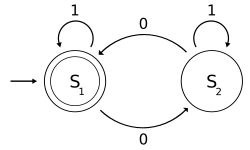
- One of the popular examples in computer scientific discipline is the mathematical models of diverse machines, an example is the deterministic finite automaton (DFA) which is divers equally an abstruse mathematical concept, but due to the deterministic nature of a DFA, it is implementable in hardware and software for solving various specific problems. For example, the post-obit is a DFA M with a binary alphabet, which requires that the input contains an even number of 0s:
-
- K = (Q, Σ, δ, q 0, F) where
- Q = {Due south 1, South 2},
- Σ = {0, i},
- q0 = Due south ane,
- F = {S 1}, and
- δ is defined by the post-obit state transition table:
- K = (Q, Σ, δ, q 0, F) where
- The state South 1 represents that in that location has been an even number of 0s in the input so far, while S two signifies an odd number. A 1 in the input does non change the state of the automaton. When the input ends, the state will show whether the input contained an fifty-fifty number of 0s or not. If the input did comprise an even number of 0s, Yard will cease in land Southward 1, an accepting state, so the input string will be accustomed.
- The language recognized by M is the regular linguistic communication given by the regular expression 1*( 0 (i*) 0 (ane*) )*, where "*" is the Kleene star, e.m., one* denotes whatever non-negative number (possibly cipher) of symbols "1".
![-\frac{\mathrm{d}^2\mathbf{r}(t)}{\mathrm{d}t^2}m=\frac{\partial V[\mathbf{r}(t)]}{\partial x}\mathbf{\hat{x}}+\frac{\partial V[\mathbf{r}(t)]}{\partial y}\mathbf{\hat{y}}+\frac{\partial V[\mathbf{r}(t)]}{\partial z}\mathbf{\hat{z}},](https://wikimedia.org/api/rest_v1/media/math/render/svg/fd8f22ac8b8b4f56b4f541adcd524f759b5ed380)
- that can be written also as:
![m\frac{\mathrm{d}^2\mathbf{r}(t)}{\mathrm{d}t^2}=-\nabla V[\mathbf{r}(t)].](https://wikimedia.org/api/rest_v1/media/math/render/svg/fc987d59f3eb6aea08a9def1a21e4441af4456ea)
- Note this model assumes the particle is a signal mass, which is certainly known to exist false in many cases in which nosotros use this model; for example, equally a model of planetary motion.
- Model of rational behavior for a consumer. In this model we assume a consumer faces a selection of due north bolt labeled i,2,...,n each with a market price p 1, p 2,..., p due north . The consumer is assumed to have an ordinal utility function U (ordinal in the sense that but the sign of the differences between two utilities, and not the level of each utility, is meaningful), depending on the amounts of commodities x one, x two,..., ten northward consumed. The model further assumes that the consumer has a budget M which is used to purchase a vector 10 1, ten ii,..., 10 n in such a style as to maximize U(x ane, 10 two,..., ten n ). The problem of rational behavior in this model so becomes a mathematical optimization trouble, that is:
-
- field of study to:
- This model has been used in a wide variety of economic contexts, such as in general equilibrium theory to show being and Pareto efficiency of economical equilibria.



- Neighbour-sensing model is a model that explains the mushroom formation from the initially cluttered fungal network.
- In computer science, mathematical models may be used to simulate computer networks.
- In mechanics, mathematical models may be used to analyze the movement of a rocket model.
See also [edit]
- Agent-based model
- All models are incorrect
- Cliodynamics
- Computer simulation
- Conceptual model
- Decision engineering
- Greyness box model
- International Mathematical Modeling Challenge
- Mathematical biological science
- Mathematical diagram
- Mathematical economics
- Mathematical modelling of infectious disease
- Mathematical finance
- Mathematical psychology
- Mathematical sociology
- Microscale and macroscale models
- Model inversion
- Scientific model
- Sensitivity analysis
- Statistical model
- Organisation identification
- TK Solver - Rule-based modeling
References [edit]
- ^ D. Tymoczko, A Geometry of Music: Harmony and Counterpoint in the Extended Common Exercise (Oxford Studies in Music Theory), Oxford University Printing; Illustrated Edition (March 21, 2011), ISBN 978-0195336672
- ^ Andras Kornai, Mathematical Linguistics (Advanced Information and Noesis Processing),Springer, ISBN 978-1849966948
- ^ Andreski, Stanislav (1972). Social Sciences equally Sorcery. St. Martin's Press. ISBN0-14-021816-5.
- ^ Truesdell, Clifford (1984). An Idiot's Avoiding Essays on Science. Springer. pp. 121–7. ISBN3-540-90703-iii.
- ^ Li, C., Xing, Y., He, F., & Cheng, D. (2018). A Strategic Learning Algorithm for State-based Games. ArXiv.
- ^ Billings S.A. (2013), Nonlinear Arrangement Identification: NARMAX Methods in the Fourth dimension, Frequency, and Spatio-Temporal Domains, Wiley.
- ^ "Thomas Kuhn". Stanford Encyclopedia of Philosophy. 13 August 2004. Retrieved 15 January 2019.
- ^ Thornton, Chris. "Motorcar Learning Lecture". Retrieved 2019-02-06 .
- ^ Pyke, 1000. H. (1984). "Optimal Foraging Theory: A Critical Review". Annual Review of Ecology and Systematics. 15: 523–575. doi:ten.1146/annurev.es.15.110184.002515.
- ^ "GIS Definitions of Terminology M-P". LAND INFO Worldwide Mapping . Retrieved January 27, 2020.
- ^ Gallistel (1990). The System of Learning. Cambridge: The MIT Printing. ISBN0-262-07113-4.
- ^ Whishaw, I. Q.; Hines, D. J.; Wallace, D. Thousand. (2001). "Dead reckoning (path integration) requires the hippocampal germination: Evidence from spontaneous exploration and spatial learning tasks in lite (allothetic) and nighttime (idiothetic) tests". Behavioural Brain Inquiry. 127 (1–2): 49–69. doi:10.1016/S0166-4328(01)00359-X. PMID 11718884. S2CID 7897256.
Further reading [edit]
Books [edit]
- Aris, Rutherford [ 1978 ] ( 1994 ). Mathematical Modelling Techniques, New York: Dover. ISBN 0-486-68131-ix
- Bough, E.A. [ 1978 ] ( 2000 ). An Introduction to Mathematical Modeling, New York: Dover. ISBN 0-486-41180-10
- Gary Chartrand (1977) Graphs as Mathematical Models, Prindle, Webber & Schmidt ISBN 0871502364
- Dubois, G. (2018) "Modeling and Simulation", Taylor & Francis, CRC Press.
- Gershenfeld, N. (1998) The Nature of Mathematical Modeling, Cambridge University Press ISBN 0-521-57095-half-dozen .
- Lin, C.C. & Segel, L.A. ( 1988 ). Mathematics Applied to Deterministic Problems in the Natural Sciences, Philadelphia: SIAM. ISBN 0-89871-229-7
Specific applications [edit]
- Papadimitriou, Fivos. (2010). Mathematical Modelling of Spatial-Ecological Complex Systems: an Evaluation. Geography, Surroundings, Sustainability 1(3), 67-80. doi:ten.24057/2071-9388-2010-3-1-67-80
- Peierls, R. (1980). "Model-making in physics". Contemporary Physics. 21: 3–17. Bibcode:1980ConPh..21....3P. doi:10.1080/00107518008210938.
- An Introduction to Infectious disease Modelling by Emilia Vynnycky and Richard G White.
External links [edit]
- General reference
- Patrone, F. Introduction to modeling via differential equations, with critical remarks.
- Plus instructor and student parcel: Mathematical Modelling. Brings together all manufactures on mathematical modeling from Plus Magazine, the online mathematics magazine produced past the Millennium Mathematics Project at the University of Cambridge.
- Philosophical
- Frigg, R. and Southward. Hartmann, Models in Science, in: The Stanford Encyclopedia of Philosophy, (Spring 2006 Edition)
- Griffiths, E. C. (2010) What is a model?
Source: https://en.wikipedia.org/wiki/Mathematical_model
0 Response to "Chemistry Unit 4 Review Mathematical Modeling of Gases"
Post a Comment