As plates are moving, what is happening to the Atlantic Ocean size?
Seafloor spreading and other tectonic action processes are the outcome of pall convection. Pall convection is the slow, churning motion of Globe's mantle. Convection currents bear heat from the lower curtain and core to the lithosphere. Convection currents likewise "recycle" lithospheric materials back to the mantle. Seafloor spreading occurs at divergent plate boundaries. As tectonic plates slowly move away from each other, heat from the mantle's convection currents makes the crust more plastic and less dense. The less-dense material rises, oft forming a mountain or elevated expanse of the seafloor. Somewhen, the crust cracks. Hot magma fueled by mantle convection bubbles upward to make full these fractures and spills onto the crust. This bubbled-upwards magma is cooled by frigid seawater to course igneous stone. This rock (basalt) becomes a new part of Earth'south crust. Mid-Ocean Ridges Seafloor spreading occurs along mid-ocean ridges—large mount ranges rising from the ocean floor. The Mid-Atlantic Ridge, for example, separates the North American plate from the Eurasian plate, and the South American plate from the African plate. The Due east Pacific Rise is a mid-ocean ridge that runs through the eastern Pacific Ocean and separates the Pacific plate from the North American plate, the Cocos plate, the Nazca plate, and the Antarctic plate. The Southeast Indian Ridge marks where the southern Indo-Australian plate forms a divergent boundary with the Antarctic plate. Seafloor spreading is not consistent at all mid-ocean ridges. Slowly spreading ridges are the sites of tall, narrow underwater cliffs and mountains. Rapidly spreading ridges take a much more gentle slopes. The Mid-Atlantic Ridge, for case, is a slow spreading center. It spreads 2-5 centimeters (.viii-2 inches) every year and forms an sea trench about the size of the Grand Canyon. The East Pacific Rise, on the other hand, is a fast spreading center. Information technology spreads about 6-sixteen centimeters (3-6 inches) every yr. There is not an ocean trench at the Eastward Pacific Rise, because the seafloor spreading is also rapid for one to develop! The newest, thinnest chaff on Globe is located nearly the center of mid-sea ridge—the bodily site of seafloor spreading. The age, density, and thickness of oceanic crust increases with distance from the mid-ocean ridge. Geomagnetic Reversals The magnetism of mid-ocean ridges helped scientists kickoff identify the process of seafloor spreading in the early on 20th century. Basalt, the once-molten rock that makes up virtually new oceanic chaff, is a fairly magnetic substance, and scientists began using magnetometers to measure the magnetism of the ocean floor in the 1950s. What they discovered was that the magnetism of the sea floor around mid-ocean ridges was divided into matching "stripes" on either side of the ridge. The specific magnetism of basalt rock is adamant by the World'southward magnetic field when the magma is cooling. Scientists determined that the aforementioned procedure formed the perfectly symmetrical stripes on both side of a mid-sea ridge. The continual process of seafloor spreading separated the stripes in an orderly pattern. Geographic Features Oceanic crust slowly moves away from mid-ocean ridges and sites of seafloor spreading. As it moves, it becomes cooler, more than dense, and more thick. Eventually, older oceanic crust encounters a tectonic boundary with continental crust. In some cases, oceanic crust encounters an active plate margin. An active plate margin is an actual plate boundary, where oceanic chaff and continental crust crash into each other. Active plate margins are often the site of earthquakes and volcanoes. Oceanic crust created by seafloor spreading in the East Pacific Ascent, for instance, may get office of the Ring of Burn down, the horseshoe-shaped pattern of volcanoes and earthquake zones around the Pacific ocean basin. In other cases, oceanic crust encounters a passive plate margin. Passive margins are not plate boundaries, but areas where a single tectonic plate transitions from oceanic lithosphere to continental lithosphere. Passive margins are not sites of faults or subduction zones. Thick layers of sediment overlay the transitional crust of a passive margin. The oceanic crust of the Mid-Atlantic Ridge, for instance, volition either become office of the passive margin on the N American plate (on the east coast of North America) or the Eurasian plate (on the west coast of Europe). New geographic features can exist created through seafloor spreading. The Red Sea, for example, was created as the African plate and the Arabian plate tore away from each other. Today, only the Sinai Peninsula connects the Middle Eastward (Asia) with North Africa. Eventually, geologists predict, seafloor spreading will completely separate the two continents—and bring together the Red and Mediterranean Seas. Mid-sea ridges and seafloor spreading can also influence ocean levels. As oceanic crust moves away from the shallow mid-ocean ridges, it cools and sinks as it becomes more dumbo. This increases the book of the ocean bowl and decreases the body of water level. For instance, a mid-sea ridge organization in Panthalassa—an ancient bounding main that surrounded the supercontinent Pangaea—contributed to shallower oceans and higher sea levels in the Paleozoic era. Panthalassa was an early form of the Pacific Body of water, which today experiences less seafloor spreading and has a much less extensive mid-body of water ridge system. This helps explain why bounding main levels have fallen dramatically over the past 80 million years. Seafloor spreading disproves an early office of the theory of continental drift. Supporters of continental drift originally theorized that the continents moved (drifted) through unmoving oceans. Seafloor spreading proves that the ocean itself is a site of tectonic activity. Keeping Globe in Shape Seafloor spreading is just one part of plate tectonics. Subduction is another. Subduction happens where tectonic plates crash into each other instead of spreading autonomously. At subduction zones, the edge of the denser plate subducts, or slides, beneath the less-dense one. The denser lithospheric material and then melts back into the Earth's pall. Seafloor spreading creates new crust. Subduction destroys sometime crust. The ii forces roughly balance each other, so the shape and diameter of the Globe remain constant.
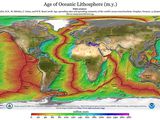
World'due south newest chaff is created at sites of seafloor spreading—red sites on this map.
Map courtesy NOAA
Triple Junctions
Seafloor spreading and rift valleys are common features at "triple junctions." Triple junctions are the intersection of three divergent plate boundaries. The triple junction is the primal bespeak where iii cracks (boundaries) split off at about 120° angles from each other.
In the Afar Triple Junction, the African, Somali, and Arabian plates are splitting from each other. The Great Rift Valley and Blood-red Sea (a major site of seafloor spreading) are the issue of plate tectonics in the Distant Triple Junction.
agile plate margin
Noun
convergent tectonic plate purlieus where an oceanic plate is crashing into a continental plate.
basalt
Noun
type of nighttime volcanic rock.
churn
Verb
to mix vigorously or violently.
Noun
steep wall of rock, earth, or ice.
consistent
Describing word
maintaining a steady, reliable quality.
Substantive
one of the vii main state masses on Earth.
continental crust
Noun
thick layer of Earth that sits beneath continents.
Noun
the movement of continents resulting from the motion of tectonic plates.
convection current
Noun
motility of a fluid from a cool area to a warm area.
Substantive
the extremely hot heart of Earth, some other planet, or a star.
Substantive
rocky outermost layer of Earth or other planet.
dense
Adjective
having parts or molecules that are packed closely together.
diameter
Noun
width of a circle.
disprove
Verb
to prove wrong.
divergent boundary
Noun
area where two or more than tectonic plates are moving away from each other. Also chosen an extensional boundary.
earthquake
Noun
the sudden shaking of Earth'due south chaff caused by the release of energy along mistake lines or from volcanic activeness.
fast spreading center
Noun
mid-body of water ridge where seafloor spreading is occuring at more than than 100 millimeters (4 inches) a year.
mistake
Noun
a cleft in the Earth'south crust where in that location has been movement.
frigid
Describing word
very cold.
geologic
Adjective
having to do with the physical formations of the Earth.
geologist
Substantive
person who studies the concrete formations of the Earth.
Noun
rock formed by the cooling of magma or lava.
Noun
outer, solid portion of the Earth. Also called the geosphere.
Noun
molten, or partially melted, rock beneath the Earth's surface.
magnetic field
Substantive
surface area around and afflicted by a magnet or charged particle.
Noun
forcefulness by which objects attract or repel one another.
magnetometer
Noun
scientific instrument used to measure out the presence, forcefulness, and direction of Globe'due south magnetic field.
Substantive
centre layer of the World, made of mostly solid rock.
mantle convection
Noun
slow motility of Globe'south solid drape acquired by convection currents transferring heat from the interior of the Earth to the surface.
Mid-Atlantic Ridge
Noun
underwater mountain range that runs from Republic of iceland to Antarctica.
mid-sea ridge
Noun
underwater mountain range.
molten
Adjective
solid fabric turned to liquid by heat.
mountain range
Substantive
series or chain of mountains that are shut together.
ocean basin
Substantive
depression in the Earth's surface located entirely below the body of water.
oceanic crust
Substantive
thin layer of the Earth that sits beneath sea basins.
Substantive
a long, deep depression in the ocean floor.
Paleozoic Era
Noun
about 541-252 1000000 years ago.
Pangaea
Noun
supercontinent of all the Earth's landmass that existed well-nigh 250 1000000 years agone.
passive plate margin
Noun
lithospheric region where oceanic crust transitions to continental crust without faults or subduction zones.
plastic
Noun
chemical material that can be easily shaped when heated to a high temperature.
Noun
move and interaction of the Earth's plates.
predict
Verb
to know the outcome of a situation in advance.
Noun
low in the ground acquired by the Earth's chaff spreading autonomously.
Noun
horseshoe-shaped string of volcanoes and earthquake sites around edges of the Pacific Ocean.
Noun
rift in underwater mountain range where new oceanic crust is formed.
Noun
base of operations level for measuring elevations. Sea level is determined by measurements taken over a 19-twelvemonth bicycle.
seawater
Noun
salty water from an sea or sea.
Substantive
solid textile transported and deposited by water, ice, and air current.
wearisome spreading center
Noun
mid-ocean ridge where seafloor spreading is occuring at less than 55 millimeters (2 inches) a year.
subduct
Verb
to pull downward or beneath something.
subduction zone
Noun
surface area where one tectonic plate slides nether another.
supercontinent
Substantive
aboriginal, giant landmass that split apart to form all the continents we know today.
symmetrical
Adjective
having the same organisation of parts on either side.
tectonic activity
Noun
motility of tectonic plates resulting in geologic activity such every bit volcanic eruptions and earthquakes.
tectonic plate
Noun
massive slab of solid stone made upwards of Earth'southward lithosphere (crust and upper mantle). Also called lithospheric plate.
theorize
Verb
to formulate and advise a group of ideas to explicate a scientific question.
transition
Noun
movement from i position to another.
transitional chaff
Noun
lithospheric region where oceanic crust transitions into continental chaff.
Noun
an opening in the Earth's crust, through which lava, ash, and gases erupt, and likewise the cone congenital past eruptions.
volume
Noun
space an object occupies.
Source: https://www.nationalgeographic.org/encyclopedia/seafloor-spreading/
0 Response to "As plates are moving, what is happening to the Atlantic Ocean size?"
Post a Comment